Your Brain Is the Biggest Rug Pull on Solana

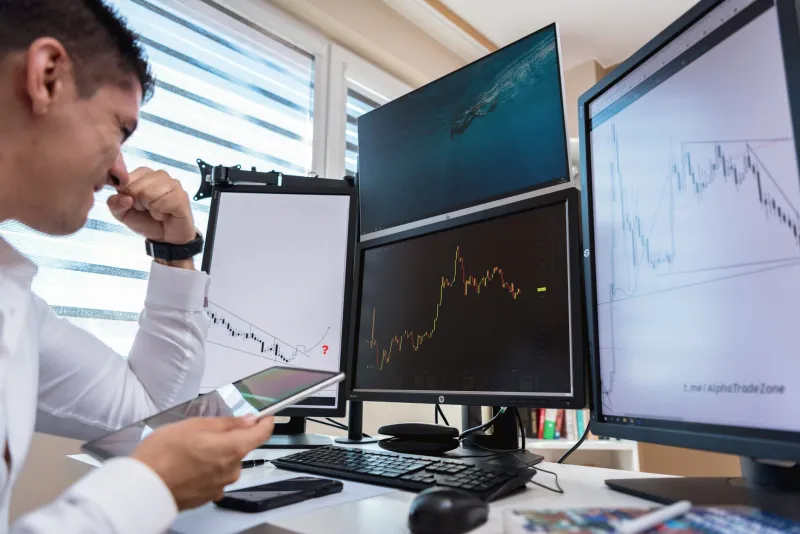
Photo: stressed trader looking at cryptocurrency charts on computer screen, via i.pinimg.com
Every Solana trader has a villain origin story. Maybe it was the 3 a.m. FOMO buy on a meme coin that had already done a 40x. Maybe it was rage-selling a legitimate project at the exact bottom because the chart looked like a ski slope. Maybe it was doubling down on a losing position because, dammit, you knew you were right.
Here's the uncomfortable truth nobody prints on a motivational poster: the market didn't beat you. Your own nervous system did.
Behavioral finance — the science of how humans actually make financial decisions versus how they should — has been studying this particular flavor of self-destruction for decades. What it's found is not flattering. And on Solana, where transactions settle in under a second and meme coins can 10x before your coffee finishes brewing, the psychological landmines are buried closer together than anywhere else in crypto.
The FOMO Tax: Solana's Most Expensive Hidden Fee
Fear of missing out isn't just a feeling. It's a measurable, repeatable cognitive error with a direct line to your wallet.
Here's how it plays out in the Solana jungle, over and over again. A token launches. Early holders post screenshots of 50x gains. The Discord lights up. Twitter (fine, X) goes feral. By the time the average retail trader sees the chart and clicks "buy," the smart money is already three steps toward the exit.
On-chain data from several high-profile Solana meme launches in 2024 told a consistent story: the largest single-hour buy volumes frequently occurred after the initial price peak, not before it. Traders weren't catching a wave — they were buying the aftermath of one. The token had already done its job. The FOMO buyers were the liquidity.
The psychological mechanism here is well-documented. Researchers call it "social proof bias" — when we see others profiting, our brains interpret that as evidence that the opportunity is real and urgent. On Solana, where everything moves at warp speed, that urgency gets turbocharged. The result is a community of otherwise intelligent people making million-dollar decisions with the deliberation of someone grabbing the last slice of pizza at a party.
Panic Selling: When the Exit Becomes the Trap
If FOMO is the disease that gets you in, panic selling is the disease that locks in the damage on the way out.
The classic pattern goes like this: a trader buys a legitimate Solana project with solid fundamentals. The market corrects — because markets always correct. The chart turns red. Social sentiment shifts. Someone in the Telegram group posts a crying emoji. And then, in a beautiful act of self-sabotage, the trader sells at a 40% loss right before the recovery.
This isn't speculation. Studies on retail investor behavior consistently show that individual investors tend to sell at or near local price bottoms, driven by what psychologists call "loss aversion" — the well-established finding that losses feel roughly twice as painful as equivalent gains feel good. Your brain is literally wired to feel worse about losing $500 than it feels good about making $500. On a volatile chain like Solana, where 30% drawdowns can happen between breakfast and lunch, that wiring is a liability.
The cruelest part? The traders who panic-sell aren't irrational in the moment. They're responding to genuine emotional distress with the tools evolution gave them: avoid the thing that's hurting you. Unfortunately, evolution didn't design those tools for a 24/7 global market that never closes and never sleeps.
Revenge Trading: The Tilt That Empties Wallets
Ask any poker player about "tilt" — that emotional state where bad beats stop being data and start being personal. Crypto has its own version, and it might be even more dangerous because there's no tournament director to kick you out when you start playing recklessly.
Revenge trading is what happens after a loss. The trader, stinging from a bad exit or a rug pull, immediately looks for the next trade to "make it back." Position sizes balloon. Due diligence shrinks. The goal shifts from growing the portfolio to settling a score with the market — which, for the record, does not know you exist and does not care.
Solana's speed makes this especially brutal. On Ethereum, the friction of gas fees and slower confirmation times at least forces a brief pause between emotional impulse and execution. On Solana, you can revenge-trade yourself into a margin call before the original wound has even stopped bleeding. The chain will process your bad decision faster than you can reconsider it.
Mental Frameworks That Actually Help
So what do you do? Acknowledging that your brain is working against you is step one. Step two is building systems that create distance between your emotions and your execution.
The 10-Minute Rule. Before entering any trade that feels urgent — any trade where your heart rate is elevated, where you're refreshing charts obsessively, where you feel like you have to act right now — set a timer for ten minutes. Do nothing. Drink water. Touch grass. If the opportunity is real, it will still be real in ten minutes. If it's gone in ten minutes, it was probably FOMO, not alpha.
Pre-Defined Exit Points. Before you enter a position, write down — literally write it down — the price at which you will sell if the trade goes wrong. Not a vague "if it drops a lot." A specific number. Then honor it mechanically, without negotiation. This is what stop-losses are for, and yet the majority of retail traders either don't use them or cancel them the moment they get close.
The Separation of Accounts Strategy. Some traders find it useful to maintain two separate wallets: one for long-term, conviction-based positions, and one for speculative plays. The psychological effect is real — when you've physically separated your "serious" money from your "play" money, you're less likely to let a bad speculative trade send you spiraling into emotional decisions about your core holdings.
Trade Journaling. This one sounds tedious because it is. Do it anyway. Keeping a record of not just what you traded but why you traded it — and how you were feeling at the time — creates a data set about your own behavioral patterns that is genuinely invaluable. Most traders who start journaling discover within a month that they have two or three specific emotional triggers that account for the majority of their worst trades.
The Market Doesn't Care About Your Feelings
Solana is a genuinely exciting blockchain. The speed, the culture, the innovation happening in its ecosystem — there are real reasons to be enthusiastic about it. But enthusiasm is not a trading strategy.
The traders who survive long enough to actually build wealth on Solana are not the ones with the best alpha or the fastest reflexes. They're the ones who figured out how to get out of their own way. They learned to recognize the feeling of FOMO as a warning sign rather than a green light. They built rules and followed them even when every emotional instinct was screaming to do otherwise.
The jungle rewards the patient ape. Not the loudest one. Not the fastest one. The one that learned to stop letting its own brain pull the rug.