The Bot Told Me So: How Automated Trading Tools Are Mass-Producing Broke Solana Traders
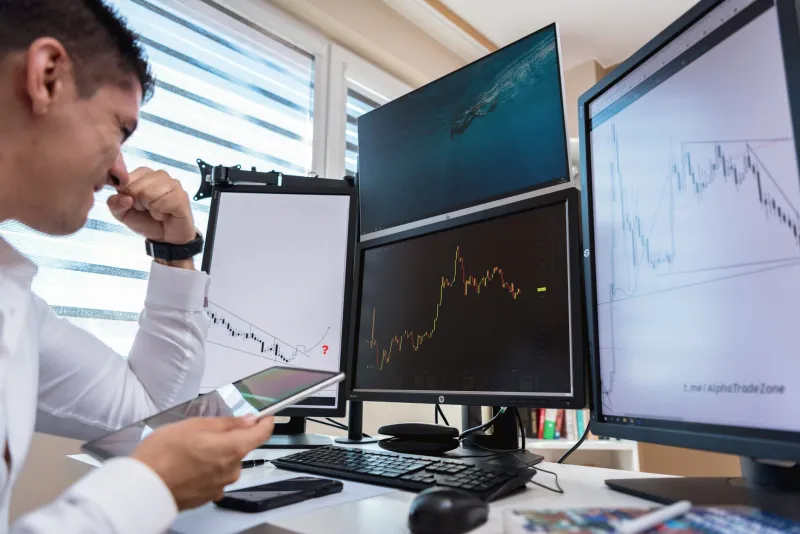
There's a particular kind of pain that hits different when you lose money and a robot made the decision for you. It's not just the empty wallet — it's the existential crisis of realizing you handed your bananas to a piece of code that learned everything it knows from yesterday's market.
Welcome to the copy-paste trading bot era on Solana, where thousands of traders convinced themselves that automation was the answer to volatility, only to discover it was actually the express lane to getting wrecked.
The Promise Was Simple. The Reality Was Not.
The pitch always sounds reasonable enough. Why spend hours staring at charts when a sophisticated algorithm can mirror the moves of a top-performing wallet in real time? Why develop your own strategy when some quant wizard has already cracked the code?
Platforms offering portfolio replication and AI-powered copy trading exploded in popularity throughout 2023 and 2024, particularly on Solana where transaction speeds make automated execution feel genuinely powerful. The low fees meant bots could fire off trades constantly without hemorrhaging money on gas — a meaningful advantage over Ethereum-based equivalents.
Traders bought in. Hard. Discord servers lit up with screenshots of green portfolios. Twitter influencers promoted their "signal channels." The ecosystem of bot-assisted trading became a genuine subculture.
Then the meme coin cycles turned, and everything got ugly fast.
When the Market Stopped Cooperating
Here's the core problem nobody wanted to talk about during the bull runs: these bots are trained on historical data, and Solana's meme coin environment generates historical data that becomes irrelevant almost immediately.
Consider what happened during several sharp sentiment reversals in early 2024. Tokens that had posted three consecutive weeks of clean upward momentum — exactly the kind of pattern bots are designed to chase — suddenly collapsed on the back of a single celebrity tweet, a coordinated FUD campaign, or just the collective attention span of crypto Twitter moving on to the next shiny object.
Bots following those momentum signals kept buying into the dip, executing their programmed logic flawlessly, right up until the wallets they were copying quietly exited their positions. By the time the algorithm detected the change in behavior, the exit liquidity had already been provided — by the bot users themselves.
One documented case involved a popular copy-trading setup mimicking a whale wallet that had posted exceptional returns across six meme tokens over two months. When the whale rotated out of three positions simultaneously in a single hour, the bots following the strategy executed their copies of those trades with a 4-to-6 minute lag. In Solana time, that lag is an eternity. The users copying the trades paid exit prices that were 15 to 30 percent worse than the wallet they were following.
The Algorithmic Blind Spots Nobody Advertises
Every bot has vulnerabilities baked into its design, and the ones targeting Solana meme coins carry some particularly nasty ones.
Liquidity blindness. Most copy-trading tools don't account for the fact that a whale executing a $200,000 exit creates a very different price impact than 400 retail traders simultaneously copying that same exit with $500 each. The aggregate behavior of the copiers becomes a market-moving force that the original strategy never anticipated.
Sentiment deafness. No algorithm currently running on Solana copy-trading platforms is reading the cultural temperature of Crypto Twitter with anything approaching human accuracy. The difference between a meme coin dip that's a buying opportunity and one that signals a community is genuinely abandoning a project often lives in the vibes — in the tone of posts, the energy of the Telegram group, the sudden silence from previously vocal holders. Bots are deaf to all of it.
The feedback loop problem. When enough traders run the same bot strategy, they create a self-reinforcing pattern that eventually implodes. If ten thousand wallets are all set to buy the same signal and sell the same signal, they're not trading against the market anymore — they're trading against each other, with the sharpest human operators positioned to front-run the entire crowd.
The False Security Spiral
Perhaps the most damaging aspect of copy-trading culture isn't the losing trades themselves — it's what the bots do to the humans running them.
Traders who outsource their decision-making to algorithms tend to stop developing market intuition. They stop reading whitepapers (such as they are in meme coin land). They stop paying attention to community dynamics. They stop noticing when a project's Discord goes from 10,000 active members to 200 overnight.
They outsource their judgment and then lose the capacity to exercise it independently. When the bot eventually fails — and it will — they're left holding a bad bag with no framework for evaluating whether to hold, sell, or rotate.
This is how copy-paste trading doesn't just lose you money on a single trade. It can leave you functionally less capable as a trader than when you started.
What Actually Works in the Jungle
This isn't an argument against using tools. Solana's ecosystem has genuinely useful on-chain analytics, wallet tracking capabilities, and portfolio management infrastructure. The difference is between using tools to inform your judgment versus using them to replace it.
The traders who've navigated Solana's meme coin cycles with their portfolios intact tend to share a few common traits. They use on-chain data as one input among several, not as an oracle. They maintain hard position size limits regardless of how confident a signal looks. They pay attention to community sentiment with the same seriousness they give to price action. And they've accepted that in an environment this volatile and this culturally driven, no algorithm is ever going to be smarter than a well-calibrated human paying close attention.
Diversification of strategy matters as much as diversification of holdings. Traders relying exclusively on a single bot approach are one market regime change away from getting completely erased.
The Jungle Has No Autopilot
Solana is fast, cheap, and genuinely exciting. It's also a market environment where conditions can shift so rapidly that strategies built on last week's data are already outdated. The apes who thrive here aren't the ones who found the best bot. They're the ones who stayed curious, stayed humble, and never fully handed their brain over to an algorithm.
The bot told you to buy. The bot told you to hold. The bot watched your portfolio go to zero with perfect, emotionless consistency.
Maybe the monkey should have been doing a little more thinking for himself.